 SmokeLess
Nicotine's plasma half-life
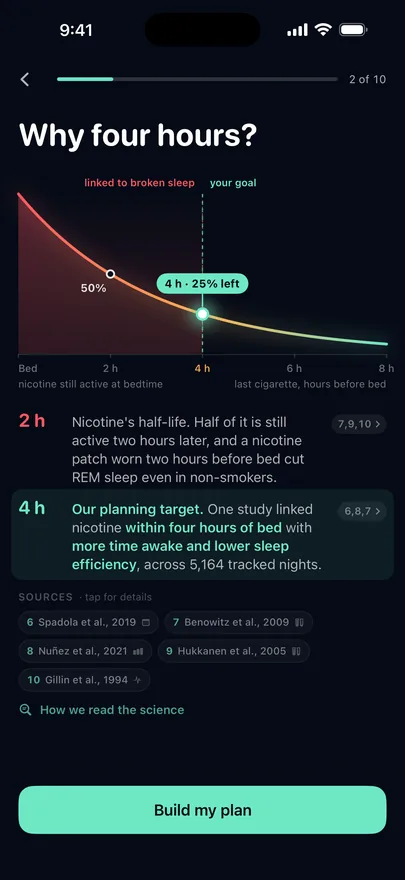
Half the nicotine from a cigarette is still circulating about two hours later, and a quarter after four. The protected window gives it time to clear. Calculate yours →
ReviewBenowitz, Hukkanen & Jacob, 2009 · PMC
SmokeLess sets a cutoff before bed and moves it earlier in small steps, from one hour to four. Not a quit plan. The same cigarettes, just not the one that costs you sleep.
Live Activity at the cutoffApple Health sleep insightsEvery claim links to its study
The evening cigarette is the one your sleep pays for. Each number below opens its study in the app.
Half the nicotine from a cigarette is still circulating about two hours later, and a quarter after four. The protected window gives it time to clear. Calculate yours →
ReviewBenowitz, Hukkanen & Jacob, 2009 · PMC
In the Jackson Heart Sleep Study, nicotine within four hours of bedtime was associated with more time awake and lower sleep efficiency that night.
CohortSpadola et al., 2019 · PMC
Across studies, smokers showed less slow-wave sleep, longer time to fall asleep and more time awake at night than non-smokers.
Meta-analysisCatoire et al., 2021 · PubMed
These are associations reported in published research, not a promise about your sleep. The four-hour target is a planning choice taken from the study window; the study did not compare cutoff lengths. Read how we read the science →
Less deep sleep, more awakenings, and why the first hours of the night take the hit.
Read → NicotineA two-hour half-life, a four-hour study window, and a step-by-step way to get there.
Read → DataWhat a pack costs around the world, with a source and year on every row.
Read →No counting cigarettes, no quit date. Set a bedtime, pick a pace, and the cutoff moves earlier in 30- or 60-minute steps.
Drag the slider. The default plan moves in 30-minute steps over four weeks. In the app you choose where the window starts (at bedtime, 30 minutes or one hour before), where it ends (two, three or four hours), the step size and a pace of 2 to 12 weeks.
One time for every day, or a different one for weekends. Days you turn off have no window.
Anywhere from two to twelve weeks. The plan timeline shows every stage before you start.
A countdown to tonight's cutoff, a reminder before it, and a Lock Screen Live Activity once the window opens.
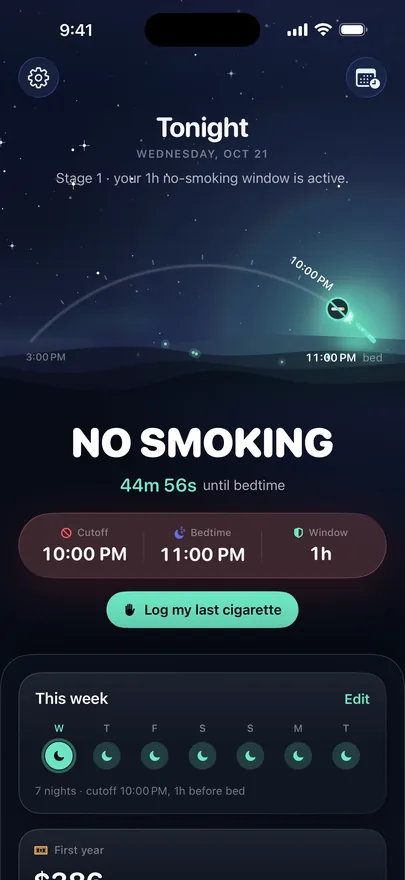
An ember crosses the evening sky toward your cutoff and cools as it gets there. Below it: the countdown, tonight's cutoff and bedtime, and the protected window. Once the cutoff passes, the screen switches to NO SMOKING and counts down to bed.
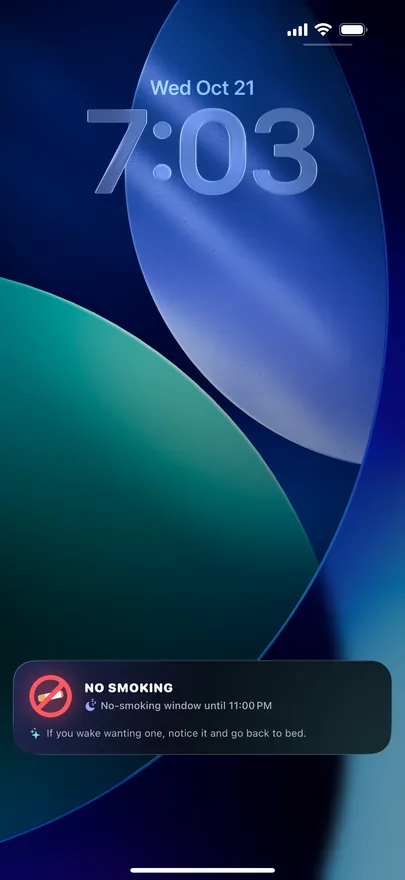
When the window opens, a Live Activity shows the no-smoking sign and when the window ends. On iOS 26 and later it starts at the cutoff by itself. On iOS 18 to 25 the reminder fires at the cutoff and the activity starts when you open the app.
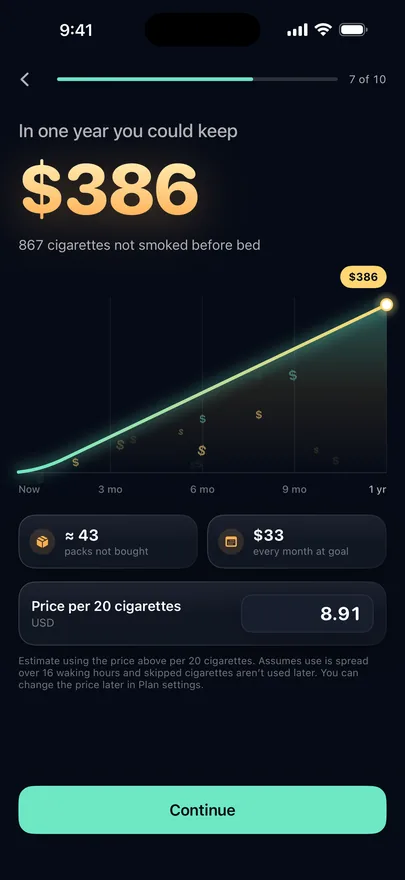
Drag across a one-year projection. The price per 20 cigarettes is filled in from a bundled, sourced dataset for your country and shown in your currency. The assumptions are stated under the chart.
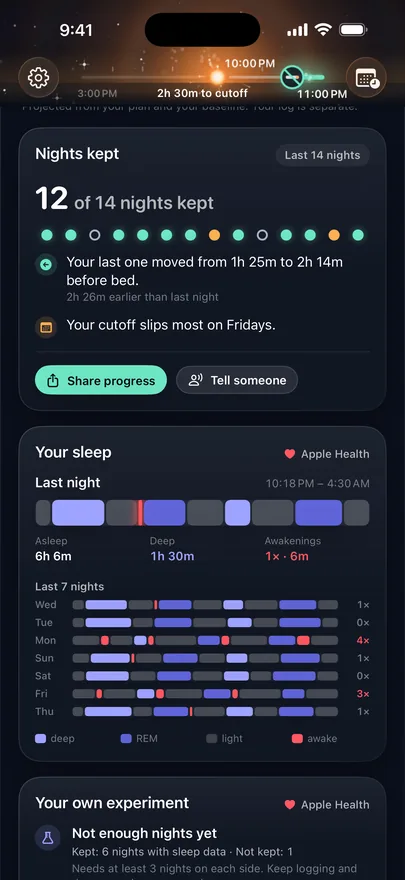
Tap “Log my last cigarette” when you put out the last one, or answer the morning check-in. The app counts the nights you kept the window and shows how far before bed your last one has moved. Connect Apple Health and the sleep card draws last night and the past seven nights as stage bars: deep, REM, light and awake.
Tap a finding or a headline number and a sheet shows the study design, who took part, the key finding, its main limitation and a PubMed link.
No. SmokeLess has one goal: move your last cigarette of the day farther from bedtime so nicotine has more time to clear before you sleep. It does not frame the plan as quitting and makes no treatment claim. If you want to stop smoking, a clinician or a quitline can help more than an app can.
Nicotine has a plasma half-life of roughly two hours, and the Jackson Heart Sleep Study associated nicotine within four hours of bedtime with more time awake and lower sleep efficiency. Four hours is a product planning target taken from that study window, when about a quarter of the nicotine is left. The study did not compare cutoff lengths, so it is not a clinically established threshold. You can aim for two or three hours instead.
Yes, optionally. With your permission it reads sleep analysis to draw your last night and last seven nights as stage bars. Access is read-only and can be turned off in the Health app at any time. The app never writes to Health.
iPhone running iOS 18 or later. On iOS 26 and later the Live Activity starts automatically at your cutoff time. On iOS 18 to 25, reminders still fire at the cutoff and the Live Activity starts when you open the app during the protected window.
SmokeLess is free, with no ads. Everyone who installs it during early access keeps every feature.
No. SmokeLess summarizes published research and links every claim to its source, but it is not medical treatment or a diagnosis. Talk to a clinician about stopping smoking, and about sleep problems that persist.
Set a bedtime, pick a pace. The cutoff moves on its own.